
Yellow-legged Asian Hornets
Yellow-legged Asian hornets are a threat to all pollinating insects, not just bees. Worker hornets from just 1 nest collect 11 kg of insects a year, that’s equivalent to approximately 96,000 small insects. If they become established, these voracious feeders with significantly reduce insect biodiversity, impacting the ability of farmers to grow many fruits and so threaten fresh food supplies.

Identification
The Yellow-legged Asian Hornet (Vespa velutina) is smaller than our native European hornet. Key identifying features include:
- Predominantly black body with a distinctive yellow or orange band on the fourth abdominal segment
- Yellow legs (hence “Yellow-legged”)
- Dark thorax with a velvety appearance
- Orange face (from the front view)
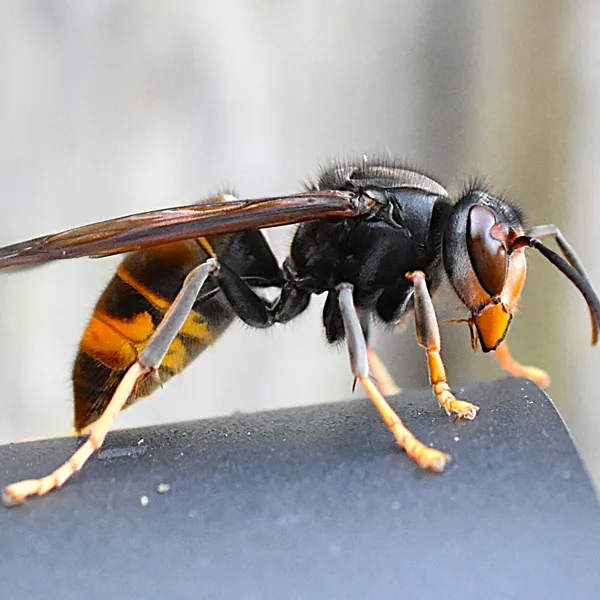
photo credit: Chris Farrell (video and audio featuring Chris)
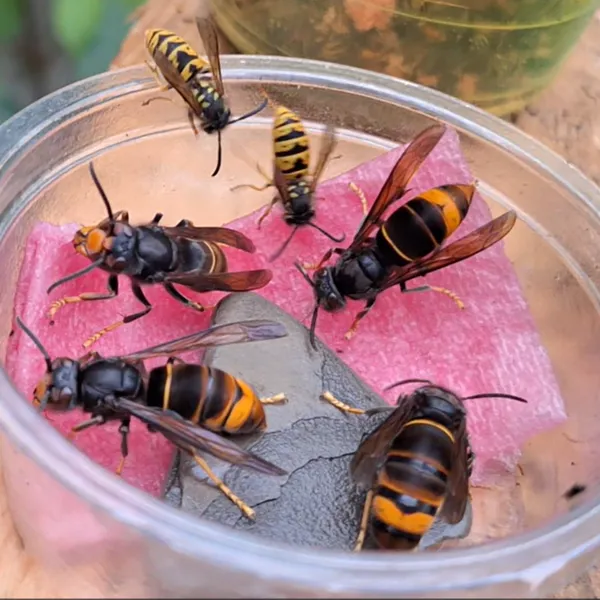
4 yellow-legged hornets, with 2 native common wasps. photo credit: Chris Farrell
Why Yellow-legged Asian Hornets Are a Threat
Yellow-legged Asian Hornets pose a significant threat to:
- Honey bees: They hunt bees to feed their larvae, often hovering outside hives to catch returning foragers
- Other pollinators: They also prey on other beneficial insects including native wasps and hoverflies
- Biodiversity: Their presence can disrupt local ecosystems and reduce pollination
Canterbury Beekeepers’ Response
The Yellow-legged Asian Hornet is well established in northern France and Belgium. Queen hornets either fly or get transported across the English Chanel and given our proximity to the Channel, Canterbury Beekeepers are on the front line of Yellow -legged Asian hornet monitoring. Our members are actively:
- Setting out monitoring traps throughout the area
- Raising public awareness about identification and reporting
- Working with local authorities and the National Bee Unit
- Training members in Yellow-legged Asian Hornet identification and response protocols
How you can help control Yellow-legged Asian Hornet numbers
The only scientifically proven way to control Yellow-legged Asian hornets is to locate and destroy their nests. Nest location involves tracking a flying hornet back to its nest, either by sight or by radio detection tracking. You can help this tracking process by attracting a hornet to a monitoring station located in your garden and reporting the sighting as explained below. Click the button below to find out when and how to create a monitoring station.
Further Information
For detailed information about Yellow-legged Asian Hornet identification, reporting procedures, and the latest updates, please visit:
⚠️ Spotted a Yellow-legged Asian Hornet?
If you think you have seen a Yellow-legged Asian Hornet, it’s crucial to report it immediately. Early detection and rapid response are essential to protect our pollinators.